Why Independent Material Advice Matters
Very little about a fiber optic cable looks demanding from the outside. Inside, the reinforcement has to protect the fibers from tension, temperature, and moisture for decades. Choosing the yarn that does this is a trade-off between competing requirements, and the engineer making it benefits from advice that is not tied to a single material.
One cable, several competing requirements
A cable design asks a reinforcement yarn to do several things at once. It has to limit elongation under installation loads, add as little weight as possible, survive the temperatures of jacket extrusion, and stay compatible with fast, clean processing. If the cable is exposed to moisture, the yarn also plays a part in blocking water along the cable.
No material leads on every axis. Aramid combines high strength with strong heat resistance. HMPE offers high strength at low weight, with lower temperature resistance, which matters when the jacket is extruded hot over the yarn. Polyester is an established choice for binder yarns and standard ripcords. TP works across HMPE, LCP, aramid, polyester, and more, which means the question always starts with the cable and your specific needs.
What independence changes
A supplier that works in one material tends to give one kind of answer. TP’s work is reinforcement across several materials, so the starting point is the application: the loads the cable carries, the temperature range, the weight target, the jacket material, and the installation conditions. The material follows from those requirements, not the other way around.
Origin is a design input too
High-performance fibers are produced in several regions, including Asia and Europe, and each route has its own profile for availability, cost, and local support. Because TP is not tied to one producer, it can discuss these trade-offs openly and source from the region that fits the project, whether the priority is competitive pricing, availability, a faster supply chain or support close to production. Wherever your material is coming from, TP always processes and tests its yarns in-house in Germany.
Where material becomes engineered yarn
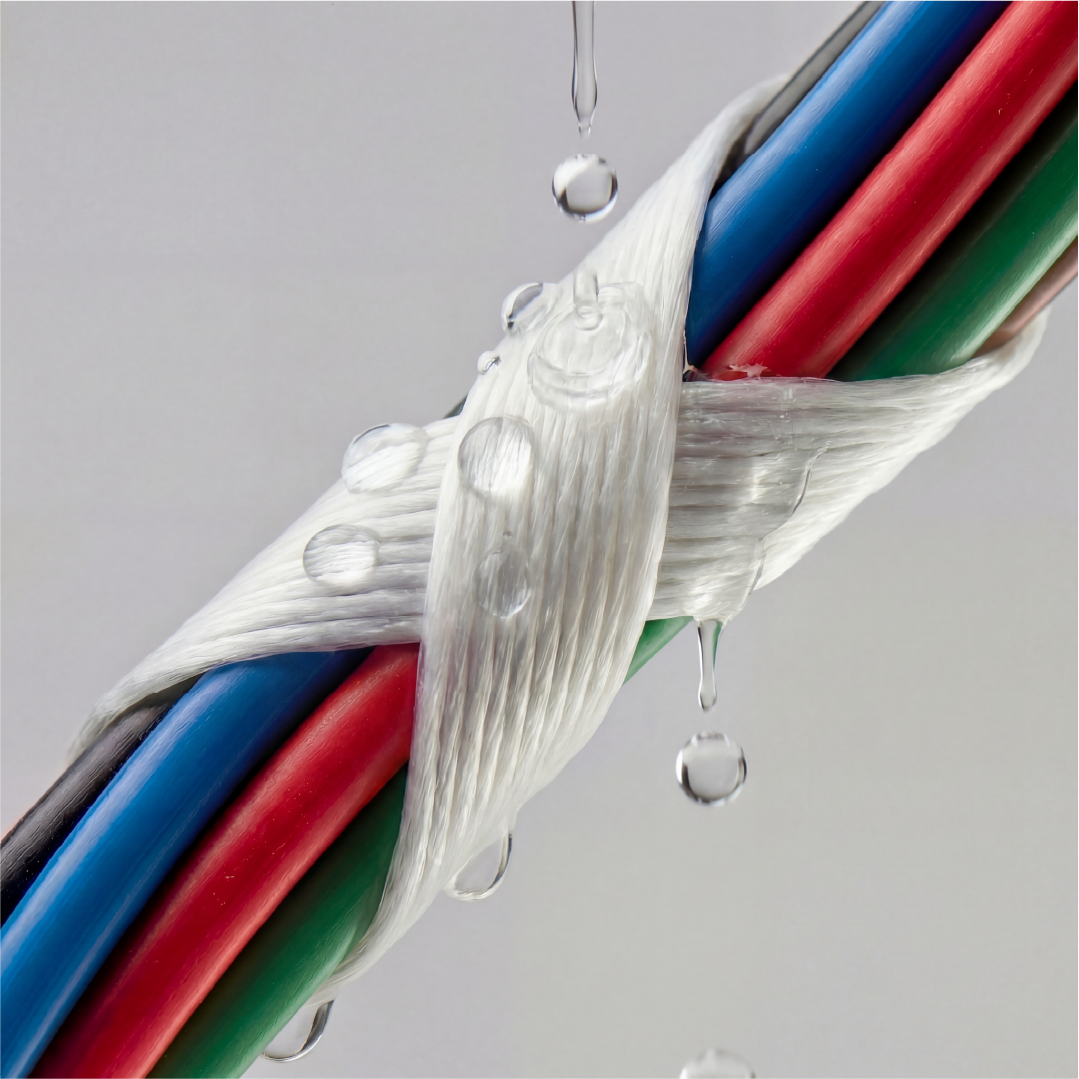
Choosing the right fiber is the first step. What happens next shapes how the yarn performs in the cable. Coating and impregnation, including the water-blocking function of the TP-AquaBlock™ system, and color coding for identification, are carried out in-house in Germany. Each yarn is tested there too, so it can be checked against the specification agreed with the customer.
Starting from the application
The most useful input for a yarn decision is the cable itself: the design, the expected loads, the jacket material, the temperature range, the water-blocking requirement, and any need for identification. TP goes through these with the customer before an order is placed, so the specification is settled first and the order follows.
Working on a fiber optic cable design and want an independent view on the reinforcement? Get in touch with TP’s specialists.