
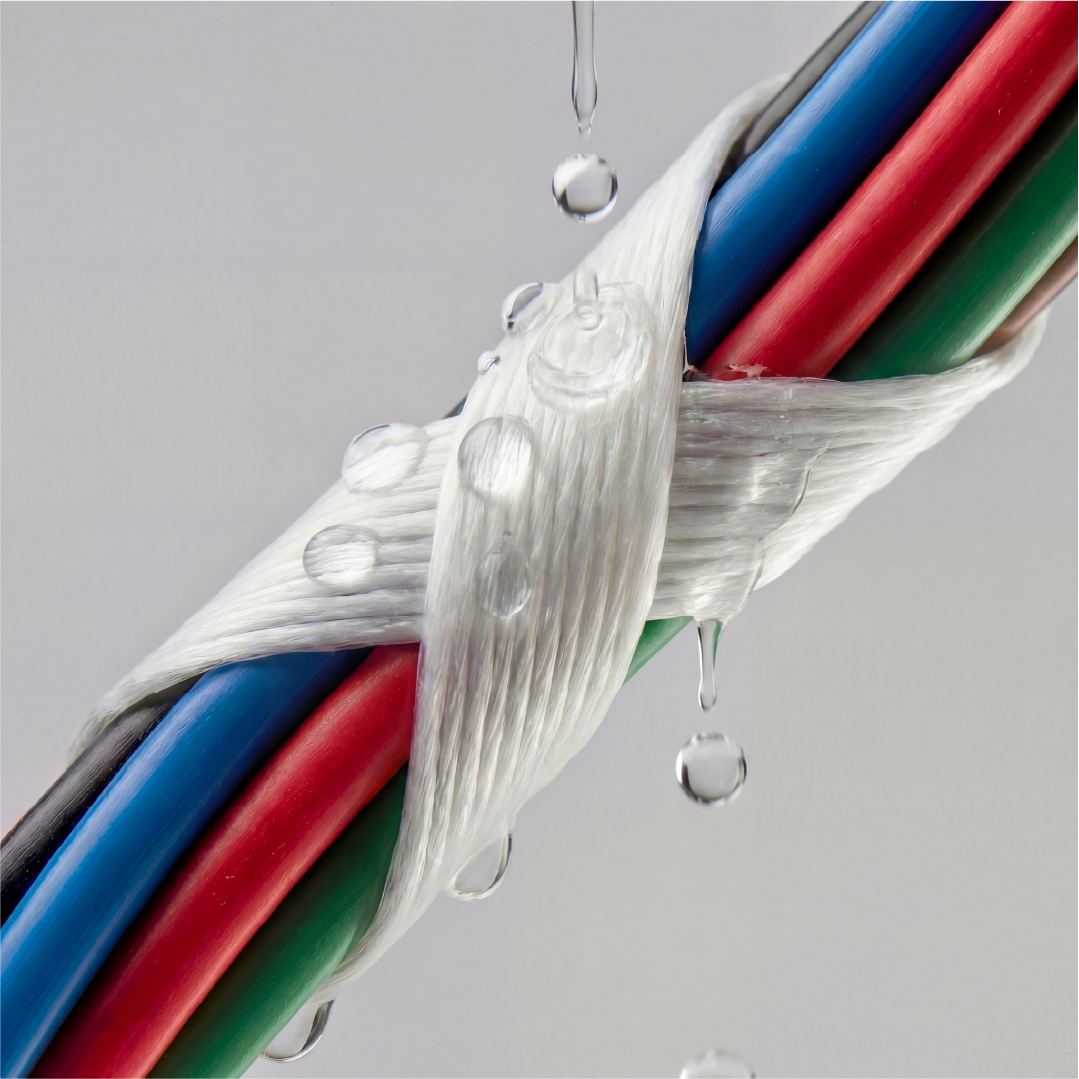
Water is one of the quieter threats to a fiber optic cable. It does not cause a dramatic, immediate failure the way a mechanical break does. Instead, it works slowly, and often far from where it entered. Understanding how it moves, and how it is stopped, is central to designing a cable that performs over decades in the ground, in ducts, or underwater.
Why water is a problem, and where it goes
When moisture penetrates a cable, several things can follow. In freezing conditions, water that has collected against the fibers can expand as it turns to ice, introducing stress and microbending that raises attenuation. Over longer periods, water can contribute to hydrogen generation inside the cable, which also degrades optical performance. But the property that makes water particularly difficult is mobility.
A cable interior is full of narrow, continuous spaces: the gaps between fibers, around buffer tubes, and alongside strength members. Water entering at a single damaged point is drawn along these spaces by capillary action, the same effect that pulls liquid up a narrow tube. This is longitudinal water migration, and it means one small breach can carry water meters or more along the cable, spreading the consequences of a single fault.
The shift from filled cores to dry water-blocking
Much of the industry has since moved toward dry water-blocking, built around superabsorbent polymers that swell into a gel on contact with water. These can be delivered as tapes, loose powder, or carried directly on a yarn, and the delivery format affects manufacturing as much as protection: loose powder, for instance, blocks water well but adds a variable to control on a clean, high-speed line.
How TP AquaBlock™ is engineered to work
TP’s approach to water-blocking, the TP AquaBlock™ system, carries the absorbent function inside the yarn structure itself, introduced through controlled fiber and yarn impregnation. The result is water-blocking performance that is uniform along the full length of the yarn, run after run, rather than dependent on how consistently a separate application step was carried out.
It also changes what happens on the production line. With no loose powder or migrating compound involved, there is nothing to shed, settle unevenly, or contaminate equipment during high-speed processing. The yarn behaves, mechanically, like the yarn it already is, so cable manufacturers do not need to adapt tension settings or line speed to accommodate an added material.
Durability follows the same logic. A surface coating or loose powder can shift, deplete, or separate from the yarn over time, particularly through the bending and handling a cable undergoes during stranding, jacketing, and installation. It stays intact through that same handling, without relying on an interface between two materials that could fail.
TP applies TP AquaBlock™ consistently across three yarn types: binder yarns, ripcords, and aramid or polyester strength yarns. That matters at a system level. A cable design that draws its water-blocking from several different technologies, one method on the binder yarn, another on the ripcord, risks gaps at the interface between them. Applying a single, consistent water-blocking principle across every yarn in the construction removes that risk and gives a cable designer one mechanism to evaluate rather than several.
Choosing an approach
There is no single correct water-blocking method for every cable. The right choice depends on the cable design, the installation environment, the manufacturing line, and how the finished cable will be spliced and maintained. What matters is understanding the trade-offs each method carries, in protection, in processing, and in the field, and matching them to the application. That is the kind of material-level decision a reinforcement specialist is positioned to advise on, independent of any single product line.


